



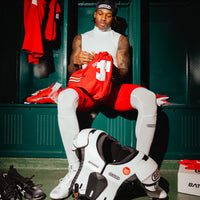
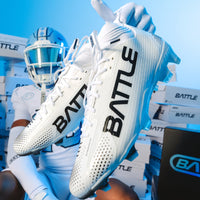








Metal cleats might give you killer traction on the baseball diamond, but they're completely banned in football at every level, from youth leagues to the NFL. The reason is simple: exposed metal spikes add unnecessary injury risk that outweighs any grip advantage.
This guide breaks down exactly why metal cleats are banned, what the rules look like across different leagues, what’s legal, and which alternatives will give you the traction and performance you need to dominate on the field.
Why Metal Cleats Are Banned in the NFL
No, metal cleats are not allowed in football at any level, including the NFL. The ban exists because metal spikes can cause serious injuries, such as cuts and punctures, during tackles and contact plays.
In fact, contact sports account for 45% of all emergency department visits for sports-related brain injuries among youth, highlighting the need for leagues to eliminate additional injury risks, such as metal cleats. Since football involves constant player collisions, metal cleats would turn every tackle into a potential medical emergency.

League Rules by Level (Youth, High School, College, Flag)
Every level of football follows the same basic rule: no metal cleats allowed. This consistency makes it easier for players and parents to understand what gear is legal as athletes move up through different leagues.
Youth and High School Rules
Youth and high school leagues have a zero-tolerance policy for metal cleats, especially since safety is the top priority for young athletes who are still developing. When shopping for young athletes, stick to youth football cleats with rubber or plastic studs that provide excellent grip without risk.
College Rules
Most NCAA programs mirror high school policies, no metal tips. Only rare exceptions exist for extreme weather on natural grass fields. Rare exceptions for challenging natural-grass conditions are unusual and must still comply with non-metal standards approved by officials.
NFL Rules
Pros must wear league-approved footwear. Players use molded cleats or detachable non-metal studs chosen for the surface and weather — no exposed metal.
Flag Football Rules
Flag football has a complete ban on metal cleats since it's a non-contact sport focused on speed and agility. The official NFL Flag rules explicitly state that metal cleats are not allowed in flag football competition.
Why Most Leagues Ban Metal Cleats
The ban on metal cleats comes down to three main safety and fairness concerns that affect every level of play.
Player Safety & Medical Risk
The main concern is player safety, as metal spikes can cause deep cuts and puncture wounds during tackles or pile-ups. Research shows that even surface choices can lead to 16% more injuries per play on certain field types, showing why leagues must eliminate equipment that could further increase the risk of injury.
Field Surface and Turf Damage
Metal cleats destroy artificial turf by shredding its synthetic fibers. On natural grass, they create dangerous divots and uneven footing that can cause ankle injuries.
Fair Play and Equipment Checks
Referees inspect equipment before games to ensure fair play, so banning metal cleats simplifies this process and prevents players from gaining unfair advantages.

What Cleats Are Legal in Football
Legal football cleats use safe materials that provide excellent traction without the dangers of metal. By understanding the different types of football cleats, you can choose the right pair for your playing style and field conditions.
Comparison Table: Allowed vs. Not Allowed
|
Cleat Type |
Material |
League Approval |
|
Molded |
Rubber/Plastic |
Allowed |
|
Detachable (Non-Metal) |
Screw-Ins |
Allowed |
|
Turf Shoes |
Small Rubber Nubs |
Allowed |
|
Metal |
Metal Spikes |
Not Allowed |
Molded vs. Detachable (Non-Metal)
Molded cleats have studs permanently attached to the sole, making them suitable for use on both grass and turf, and thus the most versatile choice. Detachable cleats feature screw-in studs that can be replaced or swapped out, allowing you to customize the stud length for different field conditions. Just make sure that the tips are non-metallic.
Stud Length, Shape & Toe Spikes
Most leagues limit stud length to around half an inch to prevent overly aggressive traction. Conical and bladed shapes are typically acceptable when made of non-metallic materials. Unlike baseball cleats, football cleats don't have toe spikes since front spikes could be dangerous during player contact.
How to Stay Compliant and Choose the Right Pair
Choosing compliant cleats protects you from penalties and keeps you on the field. Making sure your football gear meets league standards begins with selecting the proper footwear.
Step-by-Step Rule Check
Before buying cleats, verify they're legal for your specific league. Always follow these steps:
- Check your league rulebook for specific equipment requirements
- Ask your coach about team and league standards
- Inspect cleats regularly for damage that could make them non-compliant
Fit Fundamentals (Comfort + Control)
Achieving the proper fit for football cleats ensures maximum comfort and control during play. Match fit to position and surface. Linemen value stability and deep traction. Skill players (WR/DB/RB/QB) lean lighter and more flexible for acceleration and cuts. Fit should lock the heel, allow natural toe room, and feel secure in lateral moves.
Metal Cleats in Other Sports (Helpful Context)
You'll see metal cleats in sports with less direct player contact, like baseball and track, but the full-body collisions in football make them unacceptably dangerous. Any "crossover" shoe must have non-metal studs to be legal.

Safer, High-Performance Alternatives
Modern cleat technology gives you excellent traction without safety risks. The right choice depends on your position and the surfaces you play on most often. Here are some samples:
Rubber/TPU Molded
These are the most popular choice because molded cleats work on any surface, require minimal maintenance, and are approved everywhere you'll play.
Non-Metal Screw-Ins
Perfect for players who frequently face soft, wet, or muddy natural grass since you can swap in longer studs for better grip when field conditions get slippery.
Turf Shoes
Designed specifically for artificial surfaces, these shoes use small rubber nubs instead of traditional studs. They provide excellent grip without damaging synthetic fields.
Play it Safe and Fast with Battle Sports
To play your best while adhering to safety rules, you need league-approved gear that delivers elite performance. Battle Sports engineers football cleats with durable, league-legal materials designed for explosive speed and reliable traction, so you can focus on making plays instead of worrying about equipment violations.
To play fast and stay penalty-free, you need league-legal traction that converts speed into clean cuts on any surface. Battle Sports cleats are built with non-metal TPU/molded studs, lightweight uppers, and reinforced outsoles—so you can explode off the line, break down under control, and finish plays with confidence.
FAQ
Are metal cleats allowed in the NFL?
No, the NFL explicitly prohibits cleats with exposed metal and requires all players to wear league-approved footwear with molded or non-metal detachable studs.
Are detachable cleats legal in high school football?
Yes, screw-in cleats are legal in most high school leagues as long as the detachable studs are made of rubber or plastic, not metal.
Can you wear baseball cleats for football?
Are baseball cleats and football cleats the same? Nope. Wearing baseball cleats for football is not recommended because they often have illegal toe spikes and stud patterns designed for different movements than football requires.
What stud length is legal for football cleats?
Most football leagues allow maximum stud lengths of around half an inch, but you should check your specific league's rulebook for exact requirements.
Are metal cleats allowed on artificial turf?
No, metal cleats are typically banned on artificial turf. The spikes shred the synthetic fibers, which ruins the playing surface, creates tripping hazards, and results in expensive repairs.
Sources:
- CDC. (n.d.). Heads Up: Data & Statistics. https://www.cdc.gov/heads-up/data/index.html
- NFL FLAG. (n.d.). Flag Football Equipment. https://nflflag.com/flag-football-rules/flag-football-equipment
- National Center for Biotechnology Information. (2005). Artificial playing surfaces: injuries and injury prevention in football. https://pmc.ncbi.nlm.nih.gov/articles/PMC11567718/
- Snohomish County, WA. (n.d.). Tambark Creek Athletic Field. https://snohomishcountywa.gov/facilities/facility/details/Tambark-Creek-Athletic-Field-184