
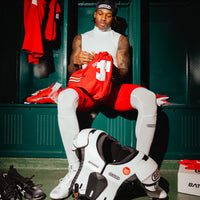
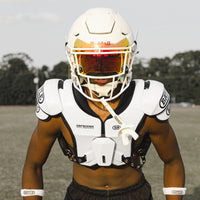
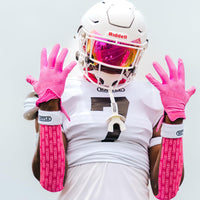
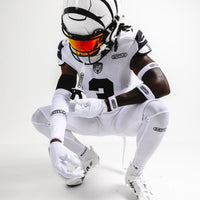
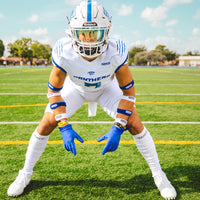



Flag football isn’t just growing, it’s taking over as the fastest-growing youth sport. With 6.2 million total participants in 20231 and a spot in the 2028 Olympics, this isn’t a trend. It’s the future of the game.
The differences between flag football vs tackle football are significant: flag football eliminates linemen, pads, and tackling, but it keeps all the strategic depth that makes football exciting.
This guide breaks down every flag football position on offense and defense, the key skills each role demands, and the rules that shape how positions work in 5v5 and larger formats. You'll learn how to match your natural abilities to the right spot on the field, whether you're a boy or girl (positions are identical regardless of gender), and discover how the right football drip helps you look and feel confident from the first snap to the last.
Flag Football Offensive Positions
A standard 5v5 offensive team puts a quarterback, center, and two or three receivers on the field. Some teams swap out a receiver for a running back depending on the play call.
One key difference? Everyone can catch. That changes everything.
Quarterback (QB)
The quarterback runs the show on every offensive play. Every snap starts in your hands.
After the center snaps the ball, the quarterback receives it and makes the decision: throw, handoff, or adjust based on the defense. Stay calm or fall behind. That’s the reality.
Most leagues have a rule preventing quarterbacks from running with the ball after the snap. Per USA Football's official rules, the quarterback cannot directly run with the ball across the line of scrimmage without first handing it off to a teammate.2 That means passing the ball becomes the primary strategy, and accuracy isn’t optional, it’s crucial.
Essential quarterback skills include:
- Precise throws: Accuracy helps win games
- Reading defenses: See it before it happens
- Proper footwork: Creates space and timing
- Leadership: Keep everyone locked in
Great quarterbacks don’t just react. They anticipate. Every play starts with the quarterback to initiate the offense.
Center (C)
The center starts every play, then becomes a weapon. The center snaps the ball, then immediately runs routes to catch passes from the quarterback. Snap, release, produce.
Defenses often forget about the center after the snap. That’s your advantage. Exploit it. Precise snaps are also critical here since the quarterback typically stands five to ten yards behind the line of scrimmage.
Great centers transition instantly from snapper to route runner without losing a step. They catch reliably in traffic and understand defensive alignments before the ball moves. Versatile players who enjoy surprising opponents with catches over the middle make excellent centers.
Wide Receiver (WR)
Wide receivers are the primary targets in the pass game. These athletes line up outside or in the slot and run specific routes designed to create separation from defenders.
To succeed here, you must possess speed, sharp footwork, and good hands. That’s how you get loose and stay open. Elite receivers understand how to get loose in coverage and adjust on the fly.
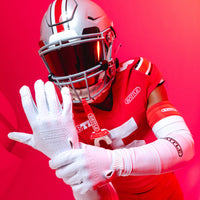
Here, quality football gloves help receivers secure every catchable ball.
If you're the fastest player on your team with reliable hands, wide receiver is your home.
Running Back (RB)
The running back takes handoffs, catches passes, and works to advance the ball on every touch. But with no-run zones in key areas, running backs must be just as dangerous catching the ball as they are carrying it.
Key running back attributes include:
- Elusiveness -Keeps runners from getting their flags pulled in the open field
- Vision - Helps running backs identify holes before they close
- Ball security - Prevents turnovers that can swing the game
- Receiving skills - Makes running backs valuable on every play, not just rushing attempts
The best backs switch seamlessly between runner and receiver depending on defensive looks. Quick, agile athletes who catch well out of the backfield dominate at this position.

Flag Football Defensive Positions
Defensive players in flag football replace tackling with flag pulls and eliminate blocking entirely. A typical 5v5 defensive team features defensive backs, a safety, and a rusher. Speed, positioning, and clean flag technique matter more than size or strength.
Defensive Back (DB)
Defensive backs match up against wide receivers in man-to-man or zone coverage. The mission is simple: prevent completions and create turnovers.
Here, quick feet allow you to mirror receivers through your routes. Reading the quarterback's eyes reveals where throws are heading before the ball releases.
Ball skills create interception opportunities that swing games. Proper flag-pulling technique requires squaring up, maintaining leverage, and pulling cleanly without grabbing jerseys.
If you're fast, reactive, an love one-on-one competition excel at defensive back.
Safety (S)
The safety operates as the last line of defense, positioned deeper than other defenders. This player prevents big plays and acts as the defensive quarterback.
Safeties are responsible for reading the field and adjusting positioning based on the play. That’s the task. Closing speed helps them recover and make plays on deep throws. When the play breaks, you fix it.
Teamwork and communication responsibilities include directing teammates and calling out offensive formations. Safeties must pull flags from multiple angles as ball carriers approach. If you're smart, instinctive and enjoy leading the defense, you belong at safety.
Rusher (R)
The rusher lines up at least seven yards behind the line of scrimmage and identifies themselves to the offense before each snap. Once the ball moves, the rusher sprints toward the quarterback to disrupt the timing.
Explosive first-step quickness closes the gap before the QB can throw. This case, change-of-direction ability helps you beat screens and misdirection plays.
Discipline means maintaining containment instead of chasing every fake. Flag-pulling at full speed requires practice and precision. If you have a burst off the line and love pressuring quarterbacks, rushing is your calling.
Linebacker (LB): 7v7 and Larger Formats
Linebackers appear in 7v7 football and larger formats as hybrid defenders. They cover running backs and short-yardage receivers while also defending against the rush.
Versatility defines great linebackers. Here, you toggle between pass coverage and run defense based on offensive formations.
Quick reads on pre-snap looks help linebackers anticipate plays. Communication with defensive backs and safeties keeps everyone aligned. Well-rounded athletes who can do a little of everything find their home at linebacker.
Key Rules That Shape Positions
Understanding flag football's unique rules explains why each position functions differently than in tackle football. These regulations create the fast, open style that makes flag football exciting.
Critical flag football rules include:
- No blocking allowed - Players set screens but cannot initiate contact. Without traditional linemen, everyone must run routes, catch passes, or defend
- Rushers start seven yards behind the line of scrimmage - Paired with a 7 second pass clock per official NFL Flag rules,3 this gives quarterbacks time while demanding closing speed from defenders
- Quarterbacks generally cannot run after the snap - This restriction emphasizes arm skill and quick decision-making over pure athleticism in most leagues
- Centers become eligible receivers immediately after snapping - This creates an extra target defenses must account for on every play
- No-contact flag pulls - Replace tackling entirely. Properly wearing your flag football belt ensures flags stay secure, and technique and angles matter more than physical size when stopping ball carriers
- No-run zones - Within five yards of midfield and the end zone, teams must pass. These areas limit running play options and keep the game open

Flag Football Positions for Girls
Every position in flag football is identical for boys and girls. The sport's design eliminates contact, allowing all players to compete at every position regardless of gender.
Girls' flag football continues expanding rapidly across the country. The NFHS reported a 105 percent increase in high school girls flag football participation from 2022 to 2024,4 and there are plenty of reasons why girls should play football. More states are now adding varsity programs every year. With flag football heading to the 2028 Olympics, the opportunity is real.
Girls should explore every position based on their athletic skills and interests. Quarterback, rusher, safety, receiver, and every other role welcomes talented players who want to compete.
Finding Your Position
If you're asking "What football position should I play?" matching your natural abilities to the right role accelerates your development. This table connects athletic traits to positions where they matter most.
|
Trait |
Best Offensive Fit |
Best Defensive Fit |
|
Speed and top-end acceleration |
Wide Receiver |
Defensive Back, Safety |
|
Agility and elusiveness |
Running Back, Wide Receiver |
Defensive Back, Rusher |
|
Arm strength and accuracy |
Quarterback |
N/A |
|
Football IQ and field vision |
Quarterback, Center |
Safety, Linebacker |
|
Explosiveness and quick burst |
Running Back |
Rusher |
|
Versatility and all-around skills |
Center, Running Back |
Linebacker, Safety |
|
Competitive one-on-one mindset |
Wide Receiver |
Defensive Back |
Most flag football players compete on both offense and defense, especially in 5v5 formats. Trying different positions early in your career builds versatility that coaches value.
There is no wrong starting position. The benefits of flag football reward players who develop skills across several roles and adapt to what their team needs.
Gear Up for Flag Football With Battle Sports
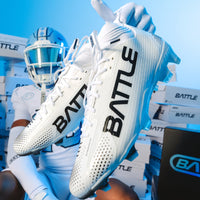
Now that you understand where you fit on the field, make sure you know what to wear for flag football so your equipment matches your ambition. Flag football players need a mouthguard for safety, gloves for grip, flag football cleats for speed, and football drip that showcase personal style.
Battle Sports builds football gear for both tackle and flag football athletes at every level. From youth leagues to competitive adult play, Battle Sports delivers the protection, grip, and confidence every position demands. The brand's durable designs and bold style help players perform their best while standing out on the field.
Flag football rewards athletes who are fast, smart, and fearless. Battle Sports creates gear for all three. Find your position, suit up with the right equipment, and score when it matters most.
Sources:
- NSGA. Flag Football Participation Growing as Opportunities for High School Girls Increasing. https://nsga.org/news/flag-football-participation-growing-as-opportunities-for-high-school-girls-increasing/
- USA Football. USA FOOTBALL. https://resources.usafootball.com/assets/usawebsite/usa-flag-5%27s-rulebook_2026.1.pdf
- NFL. REGULAR SEASON RULES 2025. https://static.www.nfl.com/image/upload/league/gxtdqh8hcquhezyzssfo.pdf
- NFHS. NFHS to Write Playing Rules for High School Flag Football. https://www.nfhs.org/stories/nfhs-to-write-playing-rules-for-high-school-flag-football