




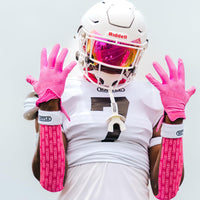
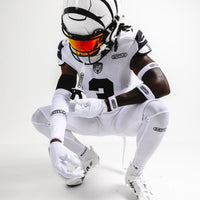
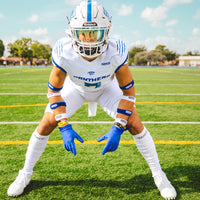



You’ve probably seen that small green sticker, that decal, on a helmet and wondered what it means.
Simply put, it marks the one player on the field who can hear the coach directly before the snap. At the highest level, that’s a big deal.
This system changed how football teams operate at the highest levels. Here's how the green-dot communication system works, who wears it, the history behind the technology, and whether it applies at the college and high school levels.
What the Green Dot on a Football Helmet Actually Means
The green dot on a football helmet identifies a one-way coach-to-player communication system. It’s placed on the back midline of the helmet, right along the front to the back, and signals that a radio receiver is built inside the helmet.
Coaches deliver instruction through their headsets, and the player listens through a tiny speaker near their ear. Only one offensive player and one defensive player per team can wear a green-dot helmet at the same time.
Officials use the sticker to verify which players are legally equipped with radio technology, keeping the sport fair for everyone on the field.

A Brief History of the Green Dot and Helmet Radios
The green dot system is a fascinating part of the evolution of football equipment, developing across decades of experimentation before becoming today's standard.
The 1956 Experiment That Started It All
Two Cleveland Browns fans built a small radio receiver and placed it inside quarterback George Ratterman's helmet. Cleveland Browns coach Paul Brown implemented radio headsets in 1956 for a handful of preseason and regular-season games, but the NFL commissioner banned the technology shortly after.1
Helmet radios then sat dormant for nearly four decades.
The NFL Legalizes Helmet Radios (1994)
A 1993 play-clock reduction created communication chaos on the field. Teams needed a faster way to communicate. So the NFL responded by legalizing one-way quarterback helmet radios starting in 1994, using analog signals until switching to digital in 2012.
Defense Gets the Green Dot (2008)
The league expanded the rule in 2008, allowing one defensive player per team to also wear a green-dot helmet. This change came partly in response to the Spygate sign-stealing scandal and completed the modern two-player system used today.
How the Green Dot Communication System Works
The radio activates when the play clock starts and is automatically cut off when the play clock reaches 15 seconds or the ball is snapped.2
Simply put:
- Coaches deliver the call through headsets
- The player hears it through a speaker
- A beep confirms the channel is closed
No delays. No confusion.
Security features also matter here, and they protect the system through:
- Encryption cycling - The system cycles through millions of encryption codes to prevent eavesdropping
- Secured storage - Teams store helmet radios in secured sideline containers when not in use, protecting against tampering between plays.

Who Wears the Green Dot on a Football Helmet?
Not just anyone gets the dot. It goes to the player leading the unit, and that’s responsibility.
It lands on different players depending on what football position is leading the unit on the field. In this case, the right football headgear matters just as much as the tech inside.
Offense — The Quarterback
On offense, it’s always the quarterback.
Every NFL quarterback's helmet comes pre-fitted with the radio receiver. While fans often wonder if quarterbacks wear gloves or other specific accessories, the one thing that's constant is that the QB always wears the green dot on offense.
Versatile players like Taysom Hill who occasionally line up at quarterback must carry two helmets and swap based on the play call. No exceptions.
Defense — The "QB of the Defense"
On defense, it usually goes to a linebacker or safety. Someone who stays on the field every snap, and can communicate across the formation. Because once the call comes in, it’s on them.
Teams designate a primary and backup green-dot defender, and only one can be on the field at a time.
Failing to notify the umpire of a substitution draws a five-yard penalty.
What the Green-Dot Player Does After the Radio Cuts Off
The job doesn't end when the speaker goes silent. The green-dot player must communicate the full play call to their 10 teammates before the snap using voice commands and hand signals.
This role demands instant recall and loud, clear communication, which are essential skills to master if you want to get better at American football. Quarterbacks typically Quarterbacks handle this in the huddle or at the line.
Defensive green-dot players have it tougher, spreading the message across a wider formation. That’s why many say it’s one of the hardest football positions on the field.
How the Green Dot System Speeds Up Modern Play-Calling
Before helmet radios, coaching staffs relied on hand signals, substitute messengers, and sideline boards. Opponents could steal these signals and anticipate plays.
Now? Everything is direct.
The green-dot system delivers private, instant communication straight into the player's ear. Here’s what the green-dot system makes available to teams:
- Faster huddles - Players receive the full call electronically and spend less time decoding signals
- Complex schemes - Coaches deliver intricate play calls with confidence
- Hurry-up offense - No-huddle packages work because communication stays electronic
- Real-time adjustments - Coaches relay tips right up to the 15-second cutoff
The Green Dot in College and High School Football
The green dot isn't exclusive to the NFL anymore. Here's where the technology stands at other levels.
College Football (NCAA)
College football recently adopted helmet radios.
The NCAA approved in-helmet radios for FBS programs starting with the 2024 season. Rules closely mirror the NFL framework, and the NCAA Football Rules Committee has since approved expansion to FCS starting in the 2025-26 academic year and permissive for Divisions II and III starting with the 2026-27 academic year.3
Managing green-dot logistics with 100+ player rosters presents unique challenges for university programs. Still, the system works.
High School Football (NFHS)
High school football doesn’t allow helmet radios. All player-worn audio and microphone devices are explicitly prohibited.
For 2026, the NFHS approved fixed electronic sideline signs for play signals, but high school programs still can't use the green-dot system.
Gear Up for Game Day with Battle Sports
Communication matters. But gear matters too.
The green dot represents one of the sport's most important communication tools, connecting coaches and players in real time. But smart play-calling only goes so far without the right equipment backing you up.
Battle Sports delivers football gloves, mouthguards, softshell football helmets, and accessories built with Battle Labs innovation to perform at every level.
Sources:
- Football Archaeology. (n.d.). Today's Tidbit... Radio Headsets of 1956. https://www.footballarchaeology.com/p/todays-tidbit-radio-headsets-of-1956
- NFL. (2025). 2025 OFFICIAL PLAYING RULES OF THE NATIONAL FOOTBALL LEAGUE. https://operations.nfl.com/media/e4sneelu/2025-nfl-rulebook-final.pdf
- NCAA. (2025). REPORT OF THE NCAA FOOTBALL RULES COMMITTEE FEBRUARY 25-27, 2025, ANNUAL MEETING. https://ncaaorg.s3.amazonaws.com/championships/sports/football/rules/Feb2025PRMFB_AnnualMeetingReport.pdf