





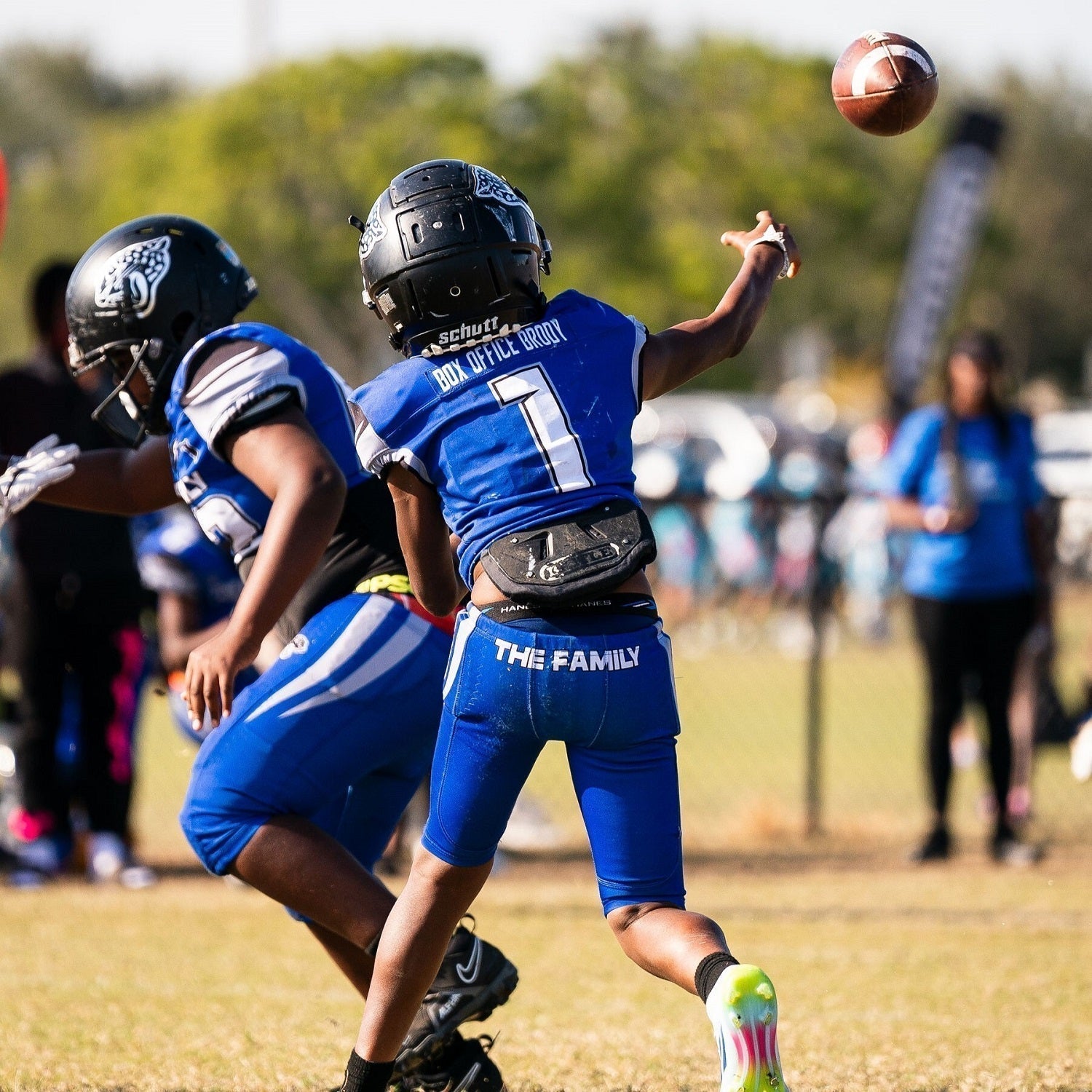
"ltr">This protection is crucial because research shows offensive players can experience around 11 high-impact events per game. Those collisions don’t just rattle helmets, they travel through your whole body, including your lower back, which is exactly where a back plate goes to work.

Why Some Quarterbacks Wear Back Plates
Quarterbacks reach for back plates for one main reason: blindside protection. Since your weight shifts forward during a throw, this leaves your spine exposed to defenders coming from multiple angles.
The NFHS officially recognizes passers as defenseless players, meaning you’re naturally exposed during your mechanics. A back plate gives you insurance on every rep, whether a defender lands cleanly or comes in hot from the blindside.
Beyond big hits, back plates also help reduce the smaller, cumulative impacts that stack up over a long season. If you want targeted lower-back protection without bulking up your torso, a back plate is the ideal solution.
Pocket Passers vs. Dual-Threat QBs
Different quarterbacks benefit from back plates in unique ways based on their playing style and exposure to hits:
- Pocket passers - Take the most vertical hits. Standing tall in the pocket equals open season on your lower back. Back Plates help you survive the chaos and keep firing on rhythm.
- Dual-threat QBs - Scramble, extend plays, and still get blasted after releasing the ball. A back plate protects you when the play breaks down.
- Mobile QBs - May usually choose ultra-light plates. This gives enough protection to take a hit, but is light enough to keep footwork fast and fluid.
Back Plate vs. Rib Protector
While a back plate focuses on spine protection, A rib protector (also called flak jackets) guards everything—ribs, sides, midsection, and lower back.
The choice ultimately comes down to coverage versus mobility. Back Plates win in mobility and freedom. Rib protectors win in coverage and protection.
If you want maximum protection (and don’t mind the bulk), rib protectors are your move. But if you want the lowest-profile protection that doesn’t fight your throw, go for a back plate. Some QBs even layer the two, but that’s a personal balance of weight versus confidence.

Quarterbacks vs. Other Positions: Who Wears Back Plates?
While QBs are catching on, back plates have been staples for running backs, receivers, linebackers, and even some linemen for years. If you take hits from behind, chase down tackles, or lower your shoulder into traffic, a back plate has probably been in your gear bag already.
Similarly, linebackers and defensive backs rely on back plates during high-impact collisions while making tackles, and linemen face their own unique protection needs in the trenches. Quarterbacks historically avoided wearing them, but that has changed thanks to lightweight designs and and curved shells for extra safety.
Your position and performance needs ultimately influence your decision to use a back plate. Since skill players value speed and flexibility, modern football back plates are engineered to be thin, curved, and completely non-restrictive.
Choosing the Right Protection for Your Game
Choosing the right back plate means finding the perfect balance of comfort, coverage, and performance. A good back plate should feel like a natural extension of your pads, not a bulky distraction.
Here are the key factors you need to look out for:
- Comfort - The plate's curve should match your back shape without digging into your waist or shoulder blades
- Coverage - The plate should sit just below the pad shell and end around belt level for full spine/kidney protection.
- Compatibility - Make sure the plate attaches securely to your specific shoulder pads
Pro tip: Try the full setup: jersey, pads, and back plate, and run through your throwing motion. If it doesn’t interfere with your torque or release, you’re good to go.
Before hitting the field, always check your league's rules. Most high school and college leagues require jerseys to completely cover all protective equipment, including back plates. The NFHS specifically lists back pads not covered as illegal equipment, so keep them covered to avoid penalties.

How to Install and Maintain Your Back Plate
Proper installation ensures your back plate stays secure and provides maximum protection on every snap.
Follow these steps to get your setup right:
- Align the back plate's top edge with the bottom of your shoulder pad's back panel
- Feed the screws or straps through the slots and secure the hardware.
- Hand-tighten only to avoid cracking the shell
- Adjust any straps so the plate sits snug and centered against your back
- Move around. Bend, twist, drop your hips to check for shifting.
Maintenance is simple. Rinse after practice, air-dry fully, and check hardware regularly. A well-secured back plate can last multiple seasons if properly maintained.
Protect Your Game with Battle Sports Football Gear
Battle Sports football back plates are engineered for one thing: absorbing impact without killing your speed. With elite dispersion tech, lightweight construction, and bold designs that look as good as they perform, they’re built for every level, from the first-year quarterback to the Friday-night gunslinger to the college playmaker.
Complete your setup with Battle Sports' full line of football gear, including gloves, cleats, and mouthguards for complete confidence, plus our football drip accessories to match your back plate and elevate your style. When you suit up in Battle gear, you're not just protected; you're ready to dominate with swagger and safety.
Sources:
- National Federation of State High School Associations. Football Points of Emphasis - 2025. https://nfhs.org/resources/sports/football-points-of-emphasis-2025
- PubMed National Institutes of Health. Epidemiology of Low Back Injuries in National Collegiate Athletic Association (NCAA) Athletes: Results From the NCAA Injury Surveillance Program Between 2009-10 and 2018-19. https://pubmed.ncbi.nlm.nih.gov/39741476/
- arXiv. Instrumented mouthguards in elite sports: Validity and head acceleration event (HAE) incidence in NCAA American Football. https://arxiv.org/abs/2502.14710